EnviroPress Reporter
BIKITA— For villagers living on the margins of Bikita Minerals, the price of losing a water point is measured not in dollars, but in kilometres walked, hours lost and the quality of water people are forced to drink.
In Murape Village, Ward 11, a community well that residents say sustained generations was cut off following the expansion of Bikita Minerals’ lithium operations and the construction of a tailings, or slime, dam.
The dispute has turned a basic question — where people get drinking water — into a test of whether mining development is improving rural lives or making them harder.
Residents told investigators that the well at Nollen Farm had been their main source of domestic water for decades. Its loss left more than 300 villagers facing longer journeys for safe water, according to reports published in 2024.
The Zimbabwe Human Rights Commission (ZHRC), which investigated the dispute, found that the well was regarded by Bikita Minerals as unsafe for human consumption and had been closed. The commission also found that a borehole had been constructed at Beardmore Primary School as an alternative, but noted that it was a considerable distance from some households.
That distance is not a minor inconvenience in a drought-prone rural district.
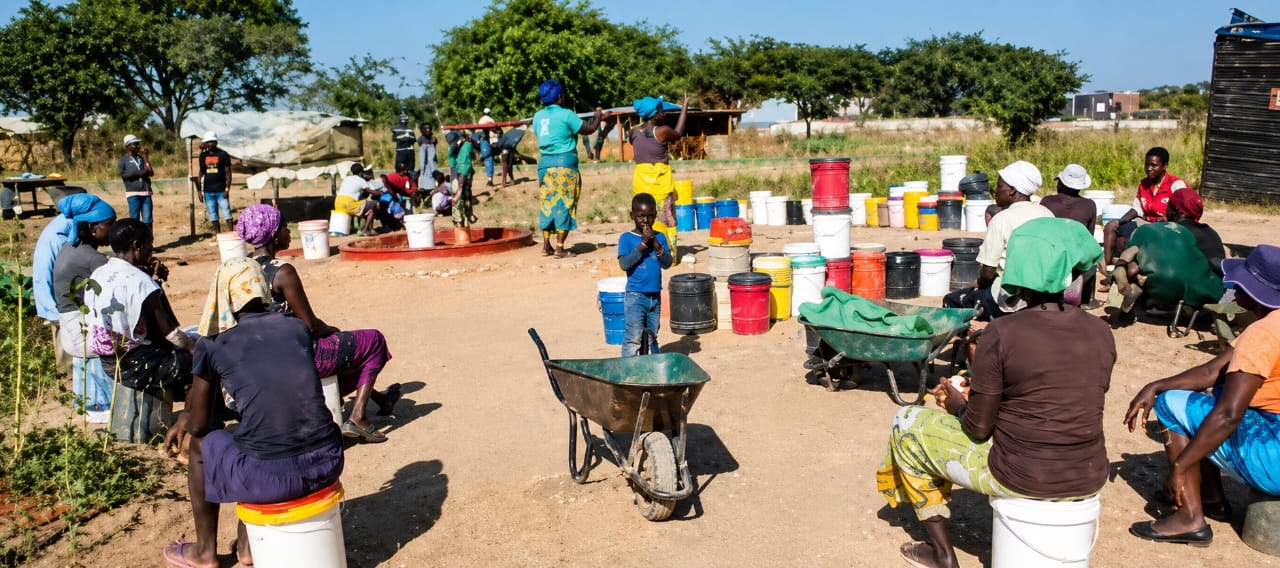
Residents interviewed by NewsHub Zimbabwe said they had resorted to abandoned mining pits for water, while a 2026 investigation reported that some villagers were walking about four kilometres to reach alternative supplies.
The irony is difficult to miss. Bikita Minerals says water access is a central part of its corporate social responsibility programme.
The company reported that it had drilled more than 36 boreholes in Bikita West and Masvingo North since 2023, while later company statements put the figure at 38 boreholes across Masvingo. Its stated objective is to keep the distance to a water source below one kilometre.
But Murape shows why the number of boreholes alone does not tell the whole story.
A water point only solves a water crisis if the people who need it can reach it safely and regularly.
In July 2025, Bikita Minerals said it had allowed the remaining Murape families to access a tap inside the mining compound while discussions over relocation and another borehole continued. The company said an additional borehole near the village was being considered.
The ZHRC has meanwhile recommended renewed efforts to relocate eight households enclosed within the mine’s boundary and further assistance with a borehole closer to villagers living far from Beardmore Primary School.
The wider Bikita experience shows that the problem is not unique. In Ward 5, NewsDay reported in 2024 that villagers from several communities were relying on a spring where people and livestock shared the same water source after household wells dried up. Health workers warned of the risk of waterborne disease.
Other interventions have brought relief. A government-Unicef piped water project in Musayize Village 15 was designed to serve more than 1,000 people, while a solar borehole funded by Delta Corporation in Nyahunda was expected to benefit more than 5,000 people.
For Bikita’s mining boom, therefore, the measure of development may be found in a deceptively simple place: the water point.
If a new mine can create jobs, roads and investment but leaves a mother walking kilometres for safe water, the cost of that missed water point is ultimately paid by the community.