EnviroPress Reporter
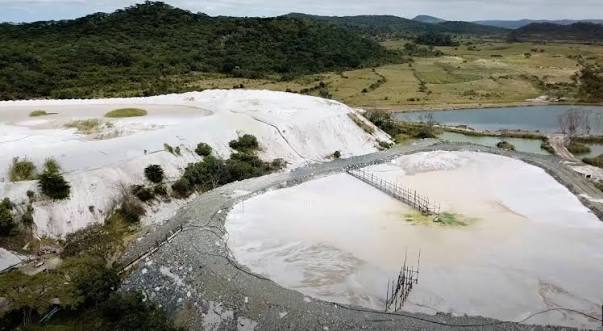
BIKITA, MASVINGO — The lithium boom has transformed Bikita from a century-old mining settlement into one of Zimbabwe’s most important battery-mineral centres. But as ore leaves the pits and concentrates head towards global markets, another legacy is accumulating closer to home: millions of tonnes of mine waste.
In 2024, Bikita Mine generated about 1.9 million tonnes of tailings, according to Sinomine Resource Group’s environmental, social and governance report. The company also reported more than 16.5 million tonnes of waste rock from its overseas mining operations, with Bikita identified in the report’s waste-management disclosures.
Tailings are the finely ground material left after valuable minerals have been separated from ore. At Bikita, the scale of processing has grown sharply since China’s Sinomine acquired the mine in 2022 for US$180 million. The company subsequently invested more than US$300 million in exploration and production expansion.
The expanded operation includes processing lines capable of handling up to two million tonnes of spodumene and two million tonnes of petalite-bearing material a year.
For communities living around the mine, however, the question is increasingly what happens to what remains after the lithium is removed.
Murape villagers in Bikita West have complained that construction of a slime dam cut off access to a long-used water source. A 2024 investigation reported that more than 300 villagers were affected and that some residents faced a journey of more than four kilometres to obtain water.
The dispute has since drawn the attention of the Zimbabwe Human Rights Commission. In its response to the allegations, Bikita Minerals said the affected land belonged to the company and that the well had been considered unsafe for human consumption. The company said it had installed a borehole at Beardmore Primary School and was working on further boreholes and relocation arrangements for households affected by the mine’s expansion.
The wider water question is not confined to Murape. In 2023, Bikita Minerals was accused of discharging effluent into Matezva Dam, a water source used by hundreds of families and an irrigation scheme. The allegations included crop damage and declining fish stocks. The company was fined US$5,000 by the Environmental Management Agency and ordered to clean up the dam, according to the Business & Human Rights Resource Centre’s compilation of the case.
Bikita Minerals disputes a number of the allegations and says it operates an ISO 14001:2015-certified environmental management system. It acknowledges that mining inevitably causes land disturbance, resource depletion and pollution, but says its environmental programme is designed to reduce those impacts.
The company also says it drilled 36 boreholes during Zimbabwe’s severe drought, providing water access to more than 5,000 people.
Yet transparency remains a point of contention. Community groups have demanded access to environmental impact assessment documents relating to the mine and its tailings facilities. In January 2026, the Bikita Land Institute of Development petitioned EMA seeking the release of EIA certificates and related documents.
The stakes are rising. Zimbabwe has moved to force greater local processing of lithium, with a ban on lithium-concentrate exports due from January 2027. Sinomine has also announced plans for a US$500 million lithium sulphate plant at Bikita.
That means more processing — and potentially more waste.
For Bikita’s villages, the lithium rush is therefore no longer only about what comes out of the ground. It is also about where the millions of tonnes left behind will go, what they will contain, and whether the water and land surrounding the mine will remain safe long after the boom has passed.