EnviroPress Reporter
BIKITA — At a mine that has grown rapidly since its acquisition by China’s Sinomine Resource Group, the right of workers to organise is no longer an abstract provision in Zimbabwe’s labour law. It is a question that touches wages, safety, job security and the ability of employees to speak collectively about conditions at one of the country’s biggest lithium operations.
Bikita Minerals was acquired by Sinomine in 2022 for US$180 million. The company says Sinomine has since invested more than US$300 million in exploration and expansion.
Its workforce has also expanded sharply: Bikita reported 1,360 direct employees in 2025, while a more recent company statement puts direct employment at 1,460, alongside more than 1,000 contractor workers.
That growth has made the question of worker representation increasingly important.
Zimbabwe’s Constitution guarantees employees, except members of the security services, the right to form and join trade unions of their choice, participate in lawful union activities, bargain collectively and organise.
The Labour Act similarly gives employees the right to join unions and participate in their lawful activities.
Bikita Minerals has said its workers are represented through a workers council and workers committee, with employees belonging to the Zimbabwe Diamond and Allied Minerals Workers Union (ZDAMWU) and the Zimbabwe Associated Mine Workers Union (ZIAMU).
The company has also previously said it pays above National Employment Council mining rates and provides bonuses, accommodation and transport.
But the existence of representative structures has not ended disputes over workers’ rights.
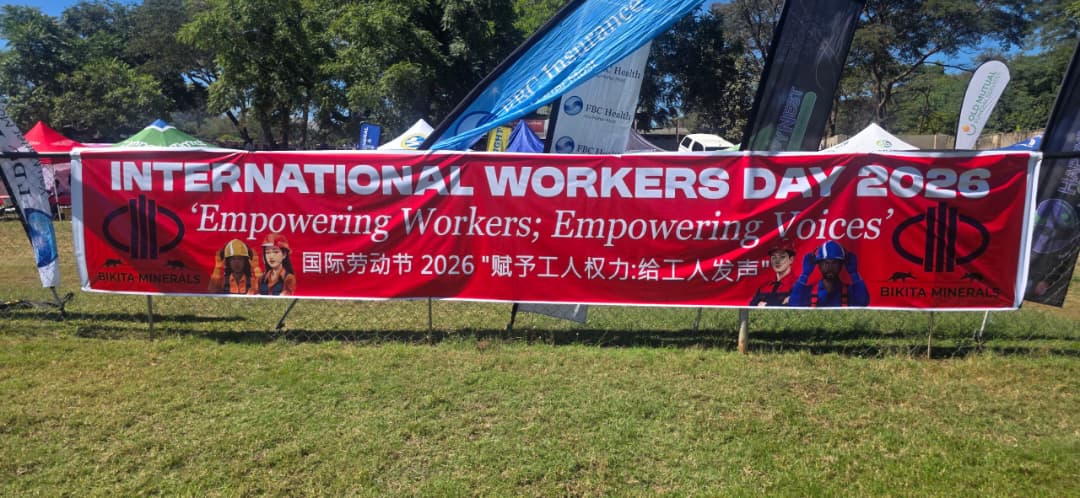
In May 2024, ZDAMWU alleged that five of its officials were threatened and chased away at gunpoint while preparing for Workers’ Day celebrations at a stadium at Bikita Minerals. The union said its tent was destroyed and one official’s phone was taken and smashed. ZDAMWU said it had 672 members at the mine and reported the incident to police and intended to approach the Labour Ministry.
The allegations were serious, particularly because they concerned a union activity at an event intended to recognise workers.
The union has also raised concerns about long working hours, alleged corruption involving contract renewals and sexual harassment at the mine. These remain allegations by the union, not findings of a court or regulator.
The wider issue is significant because collective bargaining is the mechanism through which mining workers can negotiate wages, working hours, occupational safety, benefits and dispute-resolution procedures.
Zimbabwe’s 2026 Mining Industry Collective Bargaining Agreement formally provides the framework for negotiations between employers and recognised mining unions.
Safety has added urgency to that role. In June 2026, the Centre for Natural Resource Governance said two workers connected to Bikita operations died in separate incidents.
Bikita confirmed the death of contractor employee Thomas Kaliveni following injuries sustained at a waste dump and said investigations were continuing. A separate security guard employed by another contractor was also found unresponsive while on duty.
For workers, therefore, organising is about more than union membership. It is about having an effective collective voice when decisions affect livelihoods and safety.
As Bikita expands its role in Zimbabwe’s lithium industry, the test will be whether workers can exercise that voice freely, lawfully and without intimidation — and whether management, unions and regulators can turn the legal right to organise into meaningful workplace representation.