
Trymore Tagwirei
Zimbabwe has achieved a major diplomatic victory at the 20th Conference of the Parties (CoP20) to the Convention on International Trade in Endangered Species of Wild Fauna and Flora (CITES), held in Samarkand, Uzbekistan—a development officials say marks a turning point in the country’s long-running push for the sustainable use of its wildlife resources.
Permanent Secretary in the Ministry of Environment, Climate and Wildlife, Ambassador Tadeous Chifamba, highlighted the immediate shift in global support generated by Zimbabwe’s engagement strategy.
“During the CoP, Zimbabwe’s technical team actively engaged Parties such as the European Union, Japan, China, Kazakhstan, the United States and other African Parties, and for the first time we received direct backing from both the United States and the European Union on key motions,” he said.
The Zimbabwean delegation returned home with renewed optimism after several years of unsuccessful attempts to liberalise trade in elephants, ivory and rhino horn.
The country, which holds an elephant population estimated between 91 000 and 100 000, has long argued that restrictive CITES rules deprive conservation efforts of vital funding.
Zimbabwe also holds more than 190 tonnes of ivory and several tonnes of rhino horn valued at about US$600 million, but global trade bans have prevented the resource’s utilisation.
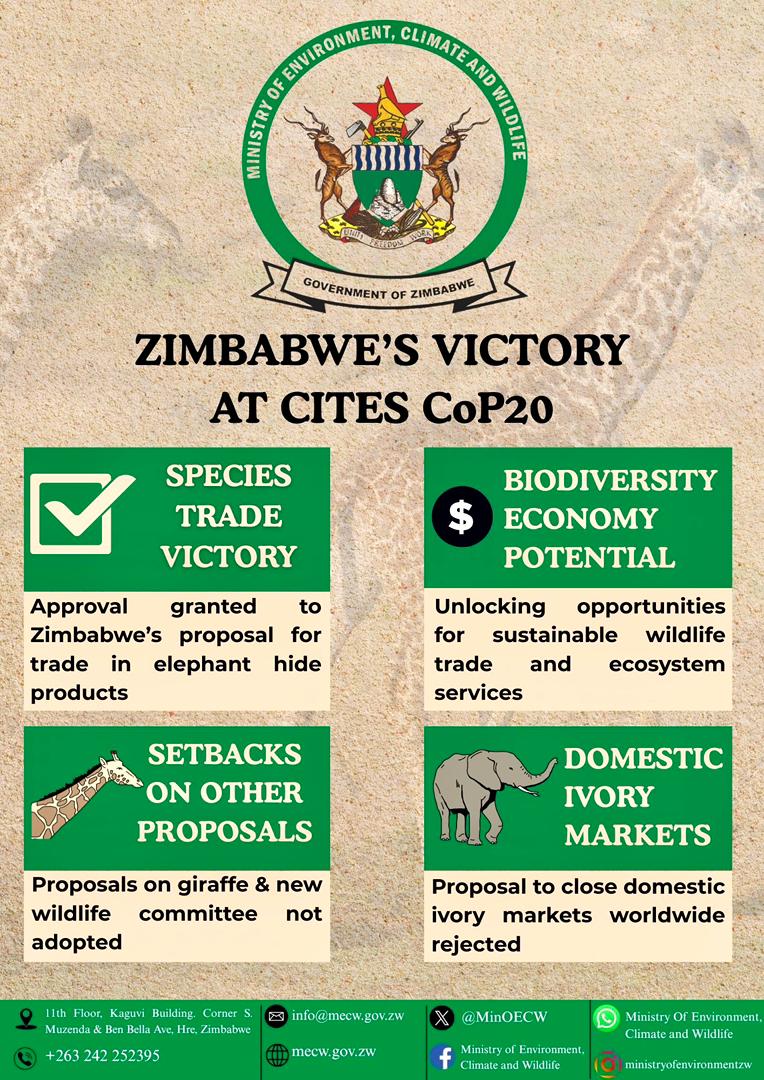
At CoP20, Zimbabwe tabled seven proposals, with Proposal 14 emerging as the most significant. After intensive negotiations with fellow African states, the proposal was adopted by consensus, lifting long-standing restrictions uniquely applied to Zimbabwe’s elephants under Appendix II.
The decision now allows the export of value-added elephant-hide products originating from natural mortality, problem animal control or herd management—a major step toward expanding the biodiversity economy.
Not all proposals succeeded. Zimbabwe’s bid to delist the giraffe from Appendix II was rejected, though officials downplayed the impact since the country holds a reservation lodged after CoP18 in 2019, allowing continued trade.
A proposal to establish an Advisory Sub-Committee to represent communities living with wildlife also failed but will be revisited during the intersessional period.
Zimbabwe welcomed the global rejection of a proposal to close all domestic ivory markets, arguing that such a measure contradicts sustainable-use principles embedded in CITES.
The country’s strengthened diplomatic presence—bolstered by its new role as Chair of the African Group of Negotiations under the African Union Commission—was credited for shifting momentum in Zimbabwe’s favour.
The unprecedented support from the United States and the European Union was seen as a major diplomatic gain.
The Ministry has already announced that export regulations will be put in place immediately to ensure Zimbabwe capitalises on the CoP20 breakthrough and accelerates growth in wildlife-based and biodiversity-linked industries.