
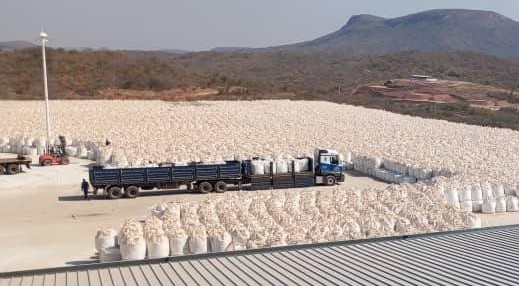
Bags of lithium concentrate at Kamativi Mine waits exportation to China. Credit: Farai Maguwu
Trymore Tagwirei
Zimbabwe’s export sector remains heavily dependent on raw minerals, a development that continues to raise concerns over the slow pace of value addition and beneficiation in the country.
According to the latest monthly economic review report by the Reserve Bank of Zimbabwe (RBZ), the country recorded merchandise exports worth US$969.4 million, with primary commodities dominating the export structure.
“Gold accounted for the largest share at 50.9% of total exports, followed by tobacco at 25.2% and Platinum Group Metals (PGMs) at 10.8%.
“Coal contributed 1.7% while steel accounted for 1.6%, with other minerals making up smaller portions.
“The country’s export structure remains highly concentrated in primary commodities, with gold contributing the largest share,” the RBZ said.
The report also highlighted Zimbabwe’s major export markets, with the United Arab Emirates (UAE) leading at 51.6%.
“Exports were mainly destined for the United Arab Emirates (51.6%), China (22.1%) and South Africa (13.4%),” said RBZ.
Meanwhile, concerns have been raised within the mining sector regarding policy unpredictability, particularly following the government’s ban on raw lithium exports.
Overall, the continued dominance of raw mineral exports underscores the urgent need for Zimbabwe to accelerate beneficiation efforts in order to maximise value from its natural resources and achieve sustainable economic development.