…community demands access to the document
Rutendo Chirume
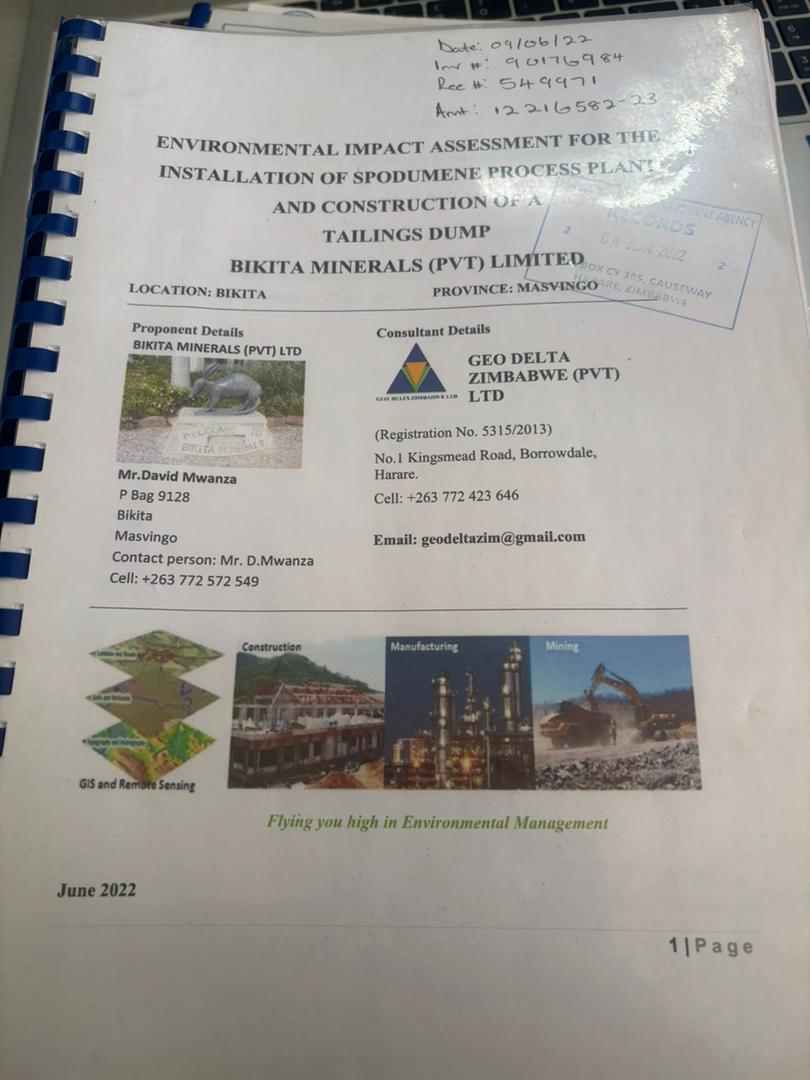
Communities in Bikita have voiced concerns against the Chinese-owned Sinomine Resource Group, accusing the lithium mining giant of withholding the Environmental Impact Assessment (EIA) report for its operations at Bikita Minerals, sparking growing concerns over environmental degradation, displacement, and unfulfilled promises.
Residents say the legally required EIA report, which outlines the potential environmental and social impacts of the mining project, has never been shared with them, leaving communities unable to verify the company’s commitments or demand accountability for damages.
Speaking during a recent community dialogue hosted by the Zimbabwe Environmental Law Association (ZELA), in collaboration with ZIMCODD, the Zimbabwe Council of Churches, and Fight Inequality Alliance Zimbabwe, villagers painted a grim picture of life in the shadow of the mine.
“Our community well was decommissioned more than a year ago due to mining activity. The company promised alternative water sources, but we are still walking long distances to fetch water while trucks loaded with lithium pass us by.
“If we had access to the EIA, we could hold them to their word,” said Rumbidzai Zinyemba of Murape Village.
Local leaders echoed the frustrations, saying the absence of an EIA reflects a disturbing lack of transparency.
“There is no EIA we know of. As a community, we are completely in the dark. This is not just neglect, it’s a violation. How can a mine operate without informing us how it will affect our land and health?” said Stella Kunedzimwe, a village head from Ward 32.
Councillors said efforts to engage the company have largely been ignored. Mercy Muradzikwa, a proportional representative councillor for Bikita, warned that without access to the EIA, the community has no way of tracking the company’s commitments or holding it accountable.
“How do we monitor promised mitigation measures if we don’t know what they are? This kind of mining — without transparency or trust — puts the whole community at risk,” said Muradzikwa.
Masvingo Provincial Environment Management Agency (EMA) confirmed that EIA is a public document which one can access after a formal request.
“The report is a public document which can be accessed when one makes a formal request for it. This document is also accessible at EMA after engagement,” said provincial spokesperson Munyaradzi Mutisi.
Civil society representatives emphasized that EIA reports are not private documents and, by law, should be publicly available at local council and Environmental Management Agency (EMA) offices.
Activists say the situation is part of a larger pattern in Zimbabwe’s resource-rich areas, where communities often bear the environmental and social costs of mining without seeing the benefits — or even knowing what agreements were made in their name.
Bikita Minerals spokesperson Collen Nikisi denied any secrecy around the EIA process.
“We confirm that thorough consultations were conducted. Key stakeholders — including Chief Marozva, Chief Chikwanda, local councillors, village heads, school headmasters, and members of the broader community — were all engaged,” said Nikisi.
He said EMA requires these consultations before issuing an EIA certificate and insisted that community voices were part of the approval process for the new spodumene processing plant, tailings dam, and power line projects.
Still, community members insist that consultation alone is not enough — what they demand now is access, transparency, and real accountability.
Chief Marozva, born Joseph Mudhe, once dismissed the EIA consultations as mere window dressing as people’s views are never respected and companies simply do them for box ticking purposes.
Read more…‘EIAs are just a tool for mining companies to get what they want’ https://enviropresszim.com/eias-are-just-a-tool-for-mining-companies-to-get-what-they-want/